



CDNLAO Newsletter
No. 106, September 2025

Throughout late 2019 and well into 2023, the National Library of Australia responded to a range of significant weather events in the protection of both its historic collection and the heritage building.
Black Summer bushfires November 2019 - February 2020
The 2019-2020 Black Summer bushfires across spring and summer in eastern and south-eastern Australia were unprecedented in terms of how far the fires spread and their force.
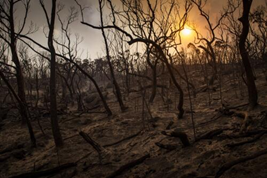
< Abbott, Matthew (2020). Aftermath of the Orroral Valley bushfire, Namadgi National Park, Australian Capital Territory, 1 February 2020. NLA Bib ID:8555381 >
Significant levels of smoke haze were first experienced in Canberra in late November 2019. The Library reduced the amount of air and smoke entering the building through the main air conditioning vents. The smoke caused the building alarm system to go into a false alarm and was a staff and public health concern. Carbon dioxide levels were also monitored for this reason.
The outside smoke haze conditions increased and following days of heavy air pollution Canberra air quality reached an extreme peak. The Library's Business Continuity Committee met each morning at 8.00am, and one aim of the meetings was to decide whether to open the building on that day. Collection storage areas, reading rooms, front foyer and exhibition spaces were monitored. No visible evidence of smoke dust settling directly on collection items on open display or in storage was found, but smoke dust was found on a range of plastic bags and sleeves that had been left out on a worktable. Further examinations found smoke dust on plastic bags housing collection items stored in drawers. This suggested that the electrostatic charge of the plastics was attracting and holding onto the fine smoke dust.
Along with predictions that the heavy smoke would continue into February and the smoke dust found on the plastic enclosures, an active smoke dust monitoring program was undertaken.
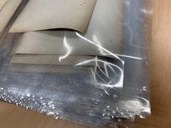
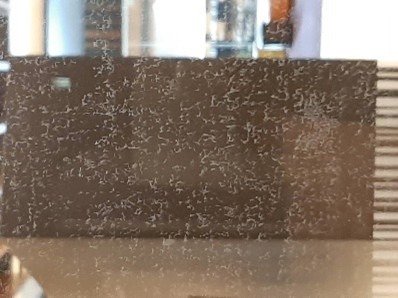
< Smoke dust found on exhibition gallery Perspex and Mylar bags >
Hailstorm 2020
One of Canberra's worst hailstorms in 21 years occurred on Monday 20 January 2020.
The large hail stones broke through the Library's heritage copper roof which caused tens of thousands of punctures and allowed water to flow into the roof cavity and into the fourth floor, used to house collections. Gutters were also seriously blocked. Every car in the Library's carpark was severely damaged, as well as many buildings and homes across the region.
The effect of the hail on the Library's roof had far reaching consequences for the Library and the care of the collection over the next three years.
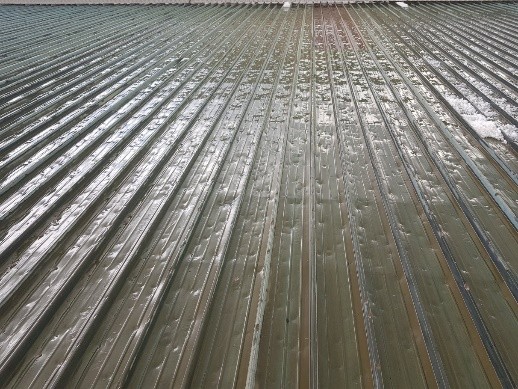
< The National Library's damaged copper roof >
Rain 2020 - 2023
The hail-damaged roof was made watertight using an orange polyethylene film that heat-shrinks to securely wrap the damaged roof. Australia then experienced a triple La Nina event between 2020 and 2023, with record rain fall and major flooding.
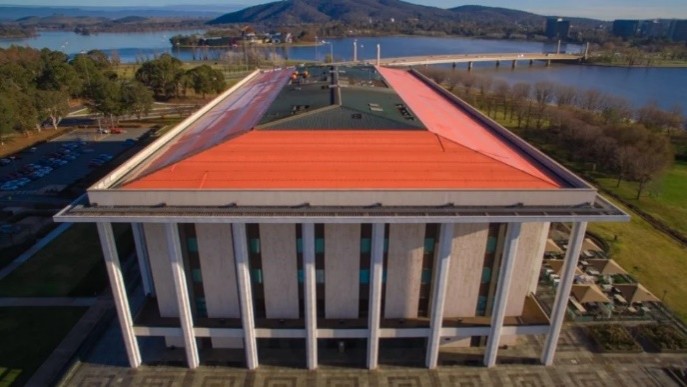
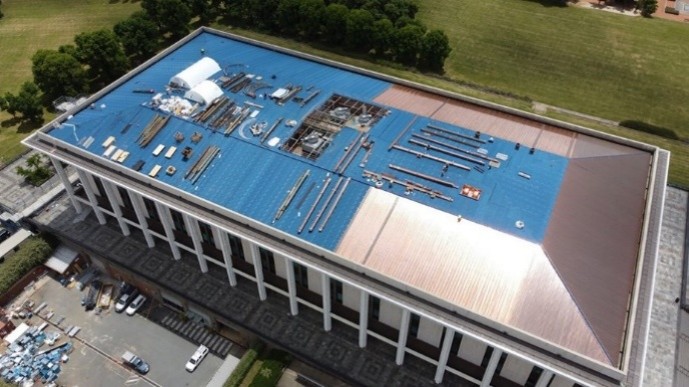
The roof work and continual rain created nine separate wet weather leak events affecting the collection. The orange protective roof wrap stayed in place across the majority of the COVID19 pandemic shut down, after which time a new roof could be constructed. The new roof is much more weather-proof, comprising ply sealed with new blue waterproof membrane and new copper sheeting. Replacing the heritage roof took more than three years, at a cost of approximately AU$14 million. Work on the roof stopped with each new rain and wind event to ensure the safety of the workers on the roof.
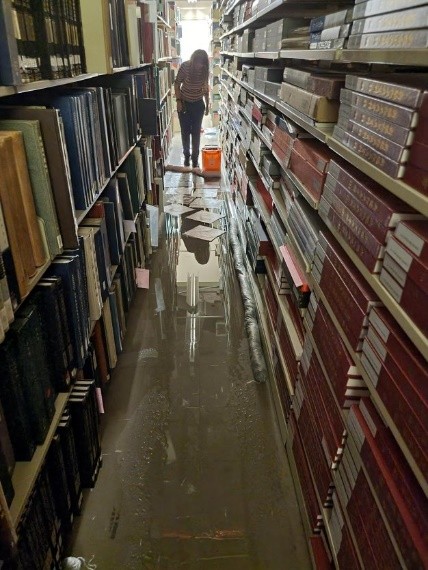
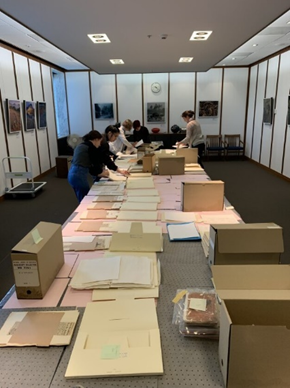
< Removing wet collections from storage and the slow drying process before return to storage >
With each forecast for rain, a physical roof wet weather check was completed. In addition to this, access to 2 collection storage areas located on the 4th floor (directly under the roof) was restricted, with the compactus fully covered with Polyweave plastic. This meant that large parts of the collection - especially Australian manuscripts - were not available for retrieval, causing serious disruptions to many planned and in-flight research projects.
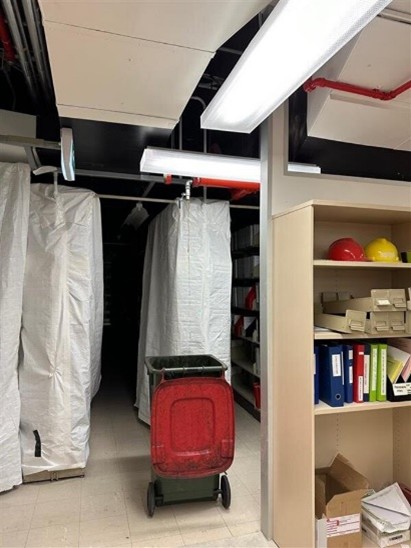
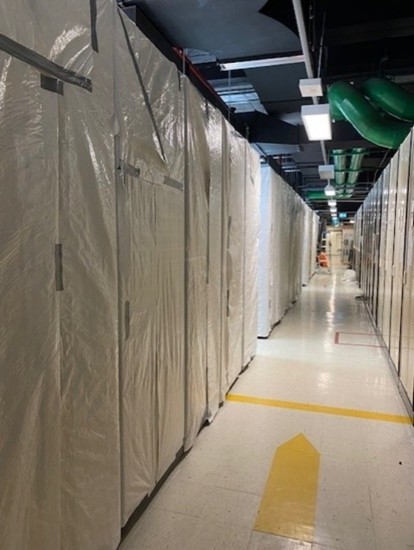
Polyweave was chosen for its water resistant nature and level of breathability to reduce the potential of mould forming in any areas where water was not easily noticeable.
After each rain event, all stack areas were checked. This pre and post rain check continued throughout 2022 into the middle of 2023 when the roof repair was finally finished, and the building was watertight.
Despite fire and smoke haze not previously experienced, a building roof damaged through a freak hailstorm, and a rare three-year heavy rain period, no unique, rare or significant collection items were either lost or damaged beyond repair.
Copyright (C) 2025 National Library of Australia


