



CDNLAO Newsletter
No. 106, September 2025

1. Introduction
On January 1, 2024, the 2024 Noto Peninsula Earthquake, with a magnitude of 7.6, occurred in the Noto region of Ishikawa Prefecture. The Noto Peninsula, where the Noto region is located, is the largest peninsula on the Sea of Japan side of central Honshu.
This earthquake caused tsunami damage, mainly in the eastern part of the Noto Peninsula, and fires, resulting in severe damage to buildings, injuries, and loss of lives. Then, in September of the same year, heavy rains also caused a disaster in the Noto region (the 2024 Oku-Noto Heavy Rains).
To rescue cultural heritage as well as provide support to libraries damaged by the earthquake and heavy rains, various public and private organizations and networks related to cultural heritage, including the Agency for Cultural Affairs, the National Institutes for Cultural Heritage (NICH), the Cultural Heritage Disaster Risk Management Center and the cultural property management departments of the affected local governments, have been working together in various ways.
As of the end of July 2025, there are still libraries in Ishikawa Prefecture that are using temporary facilities or have been forced to close.
This article provides an overview of some of the activities carried out in Ishikawa Prefecture, which was hit hard by the natural disasters, focusing on network activities that support recovery and reconstruction.
2. Activities of the Cultural Heritage Disaster Risk Management Network Promotion Council
First, I would like to introduce the Cultural Heritage Disaster Risk Management Network Promotion Council (hereinafter referred to as the "Promotion Council"), which forms the foundation for cultural heritage rescue efforts, particularly in the event of a large-scale natural disaster, and then provide an overview of its framework and activities in the above-mentioned natural disasters.
In Japan, based on the experiences of the Great Hanshin-Awaji Earthquake in 1995 and the Great East Japan Earthquake in 2011, the framework for responding to disasters has become even more comprehensive and organized. Currently, organizations related to cultural heritage in various fields participate in the Promotion Council, and while sharing information, we maintain a network to protect cultural heritage from disasters through advance preparations and to carry out rescue and support activities quickly and effectively after a disaster occurs.
As of March 2025, 28 organizations related to cultural heritage, including the NICH, are participating in Promotion Council, as well as the Japan Library Association (JLA) and the National Diet Library (NDL) participating from the library field. To outline the basic policy for how participating organizations should share information and cooperate, the Disaster Response Guidelines of the Cultural Heritage Disaster Risk Management Network Promotion Council were established. As a general scheme, in the event of a large-scale disaster that cannot be handled by prefectural or inter-prefectural cooperation alone, a Committee for Salvaging Cultural Properties Affected by Disasters will be established at the request of the Agency for Cultural Affairs based on a request for rescue from the affected prefecture, and participating organizations of the Promotion Council will become members of this rescue committee and will act while sharing information. There are no restrictions on the participating organizations starting their own actions individually.
In addition, the guidelines state that a wide variety of cultural heritage is to be covered, regardless of whether it is tangible or intangible, movable or immovable, or officially designated as a "cultural property" by the national or local government or not., One specific example of movable cultural heritage is rare materials, such as local materials and special collections, in library collections.
The Cultural Heritage Disaster Risk Management Center is in charge of the Secretariat of the Promotion Council. This center was established in October 2020, and in cooperation with various organizations and networks related to historical culture, it carries out a variety of activities as a base for a national-level disaster prevention network not only during disasters but also during normal times.
In response to the 2024 Noto Peninsula Earthquake, the Agency for Cultural Affairs decided to implement two projects: the 2024 Noto Peninsula Earthquake Cultural Properties Rescue Project (Cultural Property Rescue Project) and the 2024 Noto Peninsula Earthquake Damaged Building Rescue Support Project (Cultural Property Doctor Dispatch Project). Of these, the Cultural Property Rescue Project is a project that targets movable cultural properties such as art and craft items and ancient documents that were affected by the disaster, and involves surveying the damage, rescuing, placing items in emergency storage and taking emergency measures. To implement this project, the 2024 Noto Peninsula Earthquake Cultural Properties Rescue Committee was established and began its activities on February 13, 2024. This project is only being implemented in Ishikawa Prefecture, and the Cultural Heritage Disaster Risk Management Center, which serves as the secretariat, has set up local headquarters to carry out the activities. Until the end of June 2025, weekly meetings including the participating organizations of the Promotion Council were held online to share information on the rescue situation and activity plans. Most of the relief targets are movable cultural properties from places such as temples, shrines, and private homes, and there have been no rescue cases for library materials that were affected by the disasters.
3. Activities of university research institutes and Shiryo Net
One example of a network of university research institutes involved in the preservation of local cultural heritage is the Inter-University Research Institute Network Project to Preserve and Succeed Historical and Cultural Resources by the National Institutes for the Humanities (NIHU). With NIHU (lead institution: National Museum of Japanese History), Tohoku University, and Kobe University as its core bases, this project cooperates with networks known as Shiryo Nets ("Shiryo" means materials) established in various universities and regions to provide mutual support for the preservation, management, and utilization of historical and cultural materials, and has been participating in the rescue activities in Ishikawa Prefecture.
A Shiryo Net is a volunteer organization in which various stakeholders around a region work together. It promotes local material preservation activities as a network that transcends fields of expertise and positions. Starting with the formation of the Volunteer Network for Historical Materials (secretariat: Kobe University) in the wake of the Great Hanshin-Awaji Earthquake in 1995, many Shiryo Nets have been established throughout the country, and they are also active in practical aspects of cultural heritage rescue activities.
In response to the 2024 Noto Peninsula Earthquake, the Ishikawa Network for Preserving Historical Materials (Japanese only) (Ishikawa Shiryo Net, secretariat: Kanazawa University) was launched in March 2024 as a volunteer organization mainly made up of university instructors , local government officials, museum curators, and history researchers in Ishikawa Prefecture.
In order to preserve and pass on historical materials remaining in Ishikawa Prefecture, the Ishikawa Shiryo Net is engaged in activities to respond to large-scale disasters and promote the conservation and utilization of historical materials in preparation for disasters. In addition to participating in the Cultural Property Rescue Project mentioned above, they have been working with cultural property officials in the affected cities and towns, the Ishikawa Prefectural Museum of History, and others to transport damaged materials to temporary storage locations, organize them, and so on. Many students and graduate students have been participating in these rescue activities.
4. Support activities for libraries affected by the disasters, etc.
4.1 The activities of the Ishikawa Prefectural Library
The damage to the Ishikawa Prefectural Library (English can be selected from the menu) was relatively small, but as prefectural employees, the library staff managed to carry out the following support activities for libraries affected by the disasters in Ishikawa Prefecture while balancing disaster recovery support work through on-site dispatch and the work of running their library:
- Support work for shelving, book selection, deregistration, and transfer to temporary libraries
- Recruiting volunteers for shelving and other work using the prefectural library network
- Working with the JLA to identify needs for support at the affected libraries
- Working with the NDL to deal with water-damaged local materials;
The Ishikawa Prefectural Library requested assistance from the NDL in dealing with water-damaged local materials in a library in Ishikawa Prefecture caused by the 2024 Oku-Noto Heavy Rains. Emergency measures were carried out together with the staff members dispatched from the NDL and neighboring libraries. Subsequent restoration work was also done.
4.2 The activities of the JLA
Next, the JLA's Library Disaster Preparedness Committee (Japanese only) has been holding information exchange meetings and on-site surveys with prefectural libraries and disaster-affected libraries, in an effort to grasp the current situation and the needs for support. This information has been published on the committee's page on the JLA's website (Japanese only) and in magazine articles, and was presented at events to promote and raise awareness of disaster prevention at the National Library Conference (held annually by the JLA and others). In addition, in light of the needs for support at the affected libraries, the JLA has approached related companies and obtained their cooperation in donating book trucks and other items.
Every year, the JLA provides grants through donations to support the recovery of libraries and other facilities affected by disasters. In addition, training on disaster prevention measures is held every year. The NDL also participates as an observer in the monthly meetings of the committee.
4.3 The activities of the NDL
As part of the NDL preservation cooperation activities, we have previously provided support activities such as full-scale restoration and restoration guidance for materials damaged by the Great East Japan Earthquake in 2011 and the Kumamoto Earthquake in 2016. In addition, the NDL, as the IFLA PAC (Preservation and Conservation) Regional Centre for Asia, has been engaged in preservation cooperation activities including disaster countermeasures for materials since 1989 (see the "Preservation and Conservation" page on the NDL website).
As for this disaster, the NDL carried out the following activities:
- Providing information related to earthquakes, etc.
- Creating a collection of links to external information deemed highly necessary for disaster victims on the announcement page of the National Diet Library Great East Japan Earthquake Archive nicknamed "HINAGIKU", an archive for passing on records and lessons learned from earthquakes to future generations.
- Increasing the frequency of collection of websites from municipalities subject to the Disaster Relief Act (Act No.118 of 1947) in the National Diet Library Web Archiving Project (WARP) to collect and preserve records of disasters.
- Publishing breaking news articles when disasters occurred on the website Current Awareness, which provides up-to-date information on libraries.
- Publishing links to disaster-related information in the article "Researching about earthquakes" (Japanese only) on the website Research Navi, which introduces useful information for research by specific themes and resource groups.
- Information sharing through networks with public libraries
The theme of the Conference with Directors of Prefectural and Major Municipal Libraries held by the NDL in June 2024 was "Disasters, Disaster Prevention, and Libraries." This conference included reports from the Ishikawa Prefectural Library on the damage caused by the 2024 Noto Peninsula Earthquake and the support they had been providing followed by discussions. The Iwate Prefectural Library also introduced the prefecture's library network mutual support system in the event of a disaster. - Cooperation in rescue activities for damaged materials, etc.
- Participating in the above-mentioned Cultural Property Rescue Project in August 2024
- Dealing with water-damaged local materials in September 2024 (see the description of the activities of the Ishikawa Prefectural Library above)
- Holding an event on the theme of rescuing materials damaged by natural disasters
The theme of the 35th NDL Forum on Preservation, held by the NDL in December 2024, was "Handling Library Materials Damaged in Natural Disasters - Saving water-damaged library materials," with the aim of raising understanding of how to rescue disaster-affected materials. - New collaboration between HINAGIKU and external archives
In March 2025, HINAGIKU formed a new collaboration with the disaster recovery digital archive Noto; Kiroku To Manabi To ("Records and Learning") established by the Institute of Noto Satoumi Education and Studies in Noto Town, Ishikawa Prefecture.
In January 2025, Ishikawa Prefecture released the 2024 Noto Peninsula Earthquake Archive: Memories of the Earthquake and Records of Reconstruction (English can be selected from the menu). HINAGIKU plans to collaborate with this archive.
5. Conclusion
In Japan, there is a high probability of the occurrence of large-scale earthquakes in the near future including impending possibilities of a Nankai Trough earthquake and Tokyo inland earthquake. In addition, climate change is causing climate-related disasters to become more frequent, widespread, and severe worldwide. As such, natural disasters remain a threat to the safety and security of the country. Furthermore, local communities in Japan, which deal with such disaster risks, are facing issues such as low economic growth, declining birthrate, aging population, and population decline, and there is strong concern that their ability to prevent and respond to disasters is weakening.
The most important issue is to reduce the damage caused by disasters as much as possible. The international community shares an understanding of the importance of this point, and at the Third United Nations World Conference on Disaster Risk Reduction held in March 2015, the Sendai Framework for Disaster Risk Reduction 2015-2030 was adopted. Based on this framework, countries around the world have been working on disaster prevention and mitigation to reduce disaster risks.
In preserving local cultural heritage, it can be said that efforts related to reducing disaster risks and preparing in advance are of the utmost importance. One specific thing that will be important in this regard is to build networks for mutual support and cooperation with neighboring local governments and to put in place a system of cooperation. In order to ensure that support activities can be carried out in accordance with this framework as much as possible in the event of a disaster, necessary information will be shared during normal times and the contents of this framework will continue to be steadily improved in response to changes in the situation. This framework will naturally include cooperation with networks involved in various ways with local cultural heritage, as well as cooperation with experts and specialized organizations who understand how to rescue cultural heritage. I believe that establishing a collaborative system that enables timely, efficient and effective rescue activities will contribute to improving the resilience of local communities.
Finally, I would like to introduce one initiative that was born out of the disaster in Ishikawa Prefecture mentioned above.
In December 2024, the Ishikawa Shiryo Net planned and produced a pamphlet titled Save Disaster-affected Cultural Properties (Japanese only). The aim was to raise interest and understanding in cultural property protection and cultural property rescue activities in disaster-affected areas, prevent the loss of local historical and cultural materials, and contribute to raising awareness of rescue activities in various areas that will be carried out in the future.
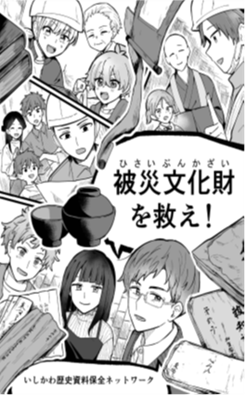
< Pamphlet title page >
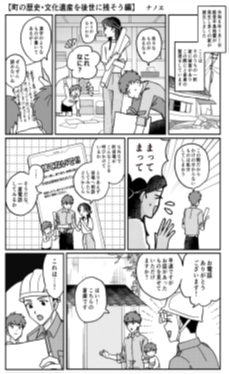
< Page 3 >
The story was created by the Ishikawa Shiryo Net based on actual rescue cases, and the scenario was written by members of the Ishikawa Shiryo Net. The illustrations were done by volunteer students from Kanazawa Gakuin University and Kinjo College (both located in Ishikawa Prefecture), with supervision and cooperation from the Cultural Heritage Disaster Risk Management Center, Noto Town Board of Education Secretariat, and Kanazawa Gakuin University.
References
AMANO Masashi, MATSUSHITA Masakazu et al. (2024) How to Preserve Local Historical Culture: Methods and Ideas for Rescuing Materials during Disasters (English version included), Bungaku-Report Co., Ltd. Fully Open Access: https://bungaku-report.com/preserve-en.html
(last access: August 28, 2025)
Copyright (C) 2025 National Diet Library, Japan


